
The life insurance industry recorded nearly 40 per cent year-on-year (Y-o-Y) growth in new business premiums (NBP), aided by the rationalisation of goods and services tax (GST) on individual life insurance premiums, which has made policies more affordable for consumers.

Among the Sensex firms, Mahindra & Mahindra jumped the most by 5.96 per cent. Bajaj Finance, Bajaj Finserv, Trent, ITC and HDFC Bank were also among the gainers. However, Maruti Suzuki India, Bharat Electronics, HCL Tech, NTPC, Power Grid, Infosys and Reliance Industries were among the laggards.

Leading automakers Maruti Suzuki, Hyundai, Mahindra, and Tata Motors saw a dip in dispatches to dealers in August amid dip in demand with many prospective buyers postponing their buys anticipating a reduction in vehicle prices on account of the new GST framework. The country's largest carmaker Maruti Suzuki India reported an 8 per cent year-on-year dip in dispatches of passenger vehicles in the domestic market last month.

Leading Indian jewellery bodies, including the All India Gem & Jewellery Domestic Council (GJC) and Malabar Gold & Diamonds, have expressed support for Prime Minister Narendra Modi's appeal to reduce gold imports and are advocating for enhancements to the Gold Monetisation Scheme (GMS) to unlock India's vast idle gold reserves.

Finance Minister Nirmala Sitharaman on Tuesday said that raising the FDI limit to 100 per cent in the insurance sector will help attract more capital, improve competition and increase insurance penetration by making policies more affordable.

'Customers do not recover the original making charges paid on old jewellery. Sentimental value is lost when heirlooms are exchanged.'
Gross GST collection grew 9 per cent to over Rs 1.87 lakh crore in October on higher revenues from domestic transactions. The Central GST collection stood at Rs 33,821 crore, State GST at Rs 41,864 crore, Integrated IGST at Rs 99,111 crore and cess at Rs 12,550 crore.

'It has always been viewed as a hedge against inflation.'

'GST reduction will help larger and high-end cars too.'

Finance Minister Nirmala Sitharaman on Monday introduced two bills in the Lok Sabha to levy excise duty on tobacco and tobacco products, and a new cess on manufacturing of pan masala, which will replace the GST compensation cess on such sin goods.

Mother Dairy on Tuesday said it will pass on 100 per cent GST reduction benefits to consumers and most of its products including value-added dairy products and processed foods (under Safal brand) will become cheaper with effect from September 22. Mother Dairy, a wholly-owned subsidiary of National Dairy Development Board (NDDB), said that prices of paneer (200 gms) will come down from Rs 95 to Rs 92, Ghee Carton Pack (1 litre) from Rs 675 to Rs 645, and butter 100 gm from Rs 62 to Rs 58.

The Group of Ministers (GoM) on goods and services tax (GST) rate rationalisation, which convened in Goa on Wednesday, reviewed the GST rates for over 100 items, including textiles, handloom goods, agricultural products, fertilisers, and educational materials. However, no consensus was reached on any of the items, with further discussions scheduled for next month in Delhi.

'LIC will reduce but not fully exit its stake in IDBI Bank, which remains an important bancassurance partner,' says LIC of India' MD and CEO R Doraiswamy.

India's second largest IT services company Infosys has been slapped with a 'pre-show cause' notice for alleged GST evasion to the tune of about Rs 32,403 crore. In a BSE filing, the Bengaluru headquartered IT firm said Karnataka State GST authorities have issued a pre-show cause notice for payment of GST of Rs 32,403 crores for the period July 2017 to March 2022, towards the expenses incurred by overseas branch offices of Infosys Ltd, and added that the company has responded to the pre-show cause notice.

Both the life and non-life insurance segment posted over 20 per cent premium growth in November for the first time in this financial year (FY26), supported by the reduction in goods and services tax (GST) on premiums from 18 per cent to zero and a favourable base effect.

Adding petrol and diesel to GST was a challenging task due to their significant role as revenue generators for both the central and state governments.

The 31st meeting of the Goods and Services Tax (GST) Council, held in December 2018, deferred a decision to reduce the GST rate for cement from 28 per cent to 18 per cent. This was despite recognising that cement - along with automobile parts - remained among the few mass-consumption items still taxed at the highest slab, which was originally meant for luxury and sin goods.


Stating that GST council meetings have become "almost toxic" with the erosion of trust between the Centre and states, West Bengal minister Amit Mitra on Wednesday urged Union Finance Minister Nirmala Sitharaman to consider a "course correction" to rebuild faith. In a letter to Sitharaman, the state's finance minister also claimed that the central government comes to GST council meetings with a "predetermined conclusion". Mitra on June 13 alleged that his voice was "muzzled" during the GST Council meeting on that day and his opposition to levy taxes on Covid essentials like vaccines, masks, PPE kits and anti-viral drug Remdesivir, was not heard.

Among Sensex firms, Bajaj Finserv, ICICI Bank, Reliance Industries, Bajaj Finance, Larsen & Toubro and Bharat Electronics were the major gainers. However, Power Grid, Eternal, Hindustan Unilever and Adani Ports were among the laggards.
The Union Cabinet on Wednesday approved changes to GST laws to levy a 28 per cent tax on the full face value of bets in online gaming, casinos and horse race clubs, sources said. The amendments to the Central GST (CGST) and Integrated GST (IGST) acts, which were approved by the GST Council last week, are likely to be introduced in the ongoing monsoon session of Parliament, which will end on August 11. The GST Council in its 51st meeting on August 2 recommended amendments to the Schedule III of the CGST Act, 2017, to provide clarity on the taxation of supplies in casinos, horse racing and online gaming.

Recalling or relabelling medicines already in the supply chain before September 22 will not be mandatory, the finance ministry said on Tuesday, issuing a fresh set of frequently asked questions (FAQs) to address industry concerns following the announcement of goods and services tax (GST) revisions.

E-sports experts say the burgeoning sector will not be affected by the Goods and Services Tax (GST) Council's recent decision to levy a blanket 28 per cent tax on online gaming, which is being viewed by the industry as a death blow to gaming companies.

Chaudhary also said that 66 per cent of government-sponsored health insurance schemes in the country are being run by the central government. "When the COVID-19 pandemic started, a decision was made for sale of all medicines at the GST rate between 5 and 12 per cent and the GST rate for COVID-19 related medicines and instruments has been reduced to five per cent," he said during the Question Hour.

The next generation GST reforms would 'absolutely' set an economy open and transparent with further reduction in compliance burden and benefiting small businesses, Union Finance Minister Nirmala Sitharaman said on Tuesday.

After the last Budget's announcement of a major tax relief for those earning an annual salary of less than Rs 12 lakh, there is not much that individuals can look forward to in the forthcoming Budget, points out A K Bhattacharya.

Union Finance Minister Nirmala Sitharaman on Tuesday said the mass consumption items such as pulses, wheat, rice, flour, and curd will not attract the 5 per cent goods and services tax (GST) when sold loose, and not pre-packed or pre-labelled. The clarification came amid protests and widespread criticism by Opposition Members of Parliament over foisting GST on daily-use essentials and subsequent price rise. The all-powerful GST Council, chaired by the Union minister, had last month decided to impose GST on some mass consumption items to simplify the rate structure, which came into effect on Monday.

Goods and Services Tax (GST) collections in September, in gross terms, were at Rs 1.73 lakh crore, with a yearly jump of 6.5 per cent, according to data from finance ministry released on Tuesday. In September 2023, the total collection was to the tune of Rs 1.62 lakh crore. CGST, SGST, IGST, and cess all increased year-on-year in September, official data made available on Tuesday showed.

The decision to hike US H-1B visa application fee to $100,000, trade talks and the GST rate cut will be the key drivers for stock market movement this week, analysts said.
In a relief for foreign firms giving loans to Indian subsidiaries, tax authorities have said goods and services tax (GST) will not be imposed on them, subject to some caveats. Additional fees, commissions, or related payments - over and above the amount charged as interest - on these loans will attract GST at 18 per cent, the Central Board of Indirect Taxes and Customs (CBIC) has said.
If other states follow suit, it is going to become difficult for the GST Council to decide on the next stage of reforms.

In absolute terms, both types of cars must cut emissions by about 28-29 g/km. But in percentage terms, the lighter 900-kg car must reduce emissions by 27 per cent, while the 1,500-kg car needs a 22 per cent cut. And the target becomes progressively stringent for both -- but, once again, the tightening is sharper for the 900-kg car than for the 1500-kg car.
'It was like rigorously preparing for a solid, good exam...' 'I don't know what marks I will get, but I felt the rigorous preparation of an exam.' 'You may sweat, but I feel rejuvenated.'

Automobile dealers' body FADA on Thursday sought a cut in GST on two-wheelers from 28 per cent to 18 per cent, saying the segment being essential for millions should not be categorised as luxury item. The industry body said it has appealed to the finance minister, chair of the GST Council, all GST Council members, the ministry of heavy industries, which supervises the automobile sector, and the ministry of road transport & highways. This timely and decisive intervention would help in making two-wheelers more affordable, reviving demand and reinvigorating an industry that has seen a significant slump in sales over the past few years, the Federation of Automobile Dealers Associations (FADA) said in a statement.

Leading FMCG companies have announced a price cut on their products, including soaps, shampoo, baby diapers, toothpaste, razors, and after-shave lotions, effective from September 22 to extend the GST rate cut benefits to consumers. Firms such as Procter & Gamble, Emami and HUL have come up with new price lists which have been communicated to their respective distributors and consumers through their respective websites.
The GST Council in its next meeting may look at raising the lowest tax slab to 8 per cent, from 5 per cent, and prune the exemption list in the Goods and Services Tax regime as it looks to increase revenues and do away with states' dependence on Centre for compensation, sources said on Sunday. A panel of state finance ministers is likely to submit its report by this month end to the Council suggesting various steps to raise revenue, including hiking the lowest slab and rationalising the slab. Currently, GST is a four-tier structure attracting a tax rate of 5, 12, 18 and 28 per cent.

'States should be compensated for the revenue loss for at least five years or beyond till the revenue stabilises.'
The principal commissioner has been made responsible for developing and approving any intelligence, conducting search, and completing investigations and relevant subsequent actions, including at the lower field formations, points out T N C Rajagopalan.

The 50 per cent US tariff on Indian goods pose a downside risk to growth but the impact is expected to be short-lived for the economy, and consumption demand could see an uptick after the new goods and service tax (GST) rates are implemented which could even offset the external uncertainty, Chief Economic Advisor (CEA) V Anantha Nageswaran reckoned on Friday.
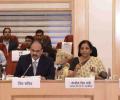
After the GST Council's meeting in March, the Centre had sought views from Attorney General K K Venugopal -- who is the chief legal officer of the government -- on the legality of market borrowing by the council to make good any shortfall in the compensation fund. The AG in his view said there is no obligation on the central government to pay the GST compensation shortfall, according to the sources.
